A Comet is an object that it revolves around the Sun like planets and asteroids, but it has a very eccentric orbit (It can be elliptical, parabolic or hyperbolic), it consists of ice, dust and rock.
Comets are object with irregular shaped objects such as satellites, but when they approach the Sun, they heat up and the ice sublimes creating an atmosphere termed "The Coma" and a Tail.
The Coma surround the nucleus and the Tail is a linear sections consisting of dusty or gas dragged out of the nucleus by the solar wind and radiation.
Some comets are "periodic comets" they have an elliptical orbits, as approaches to the Sun, they sublimate their mass (Forming a Coma and Tail), but these disappear when consumed all their mass.
Other comets approach the Sun only once, they have a parabolic or hyperbolic orbit, therefore, after to approach the sun they head into interstellar space.
Star Clusters are astronomical objects, they are composed of many stars.
There are two types of clusters: Globular Clusters and Open Clusters.
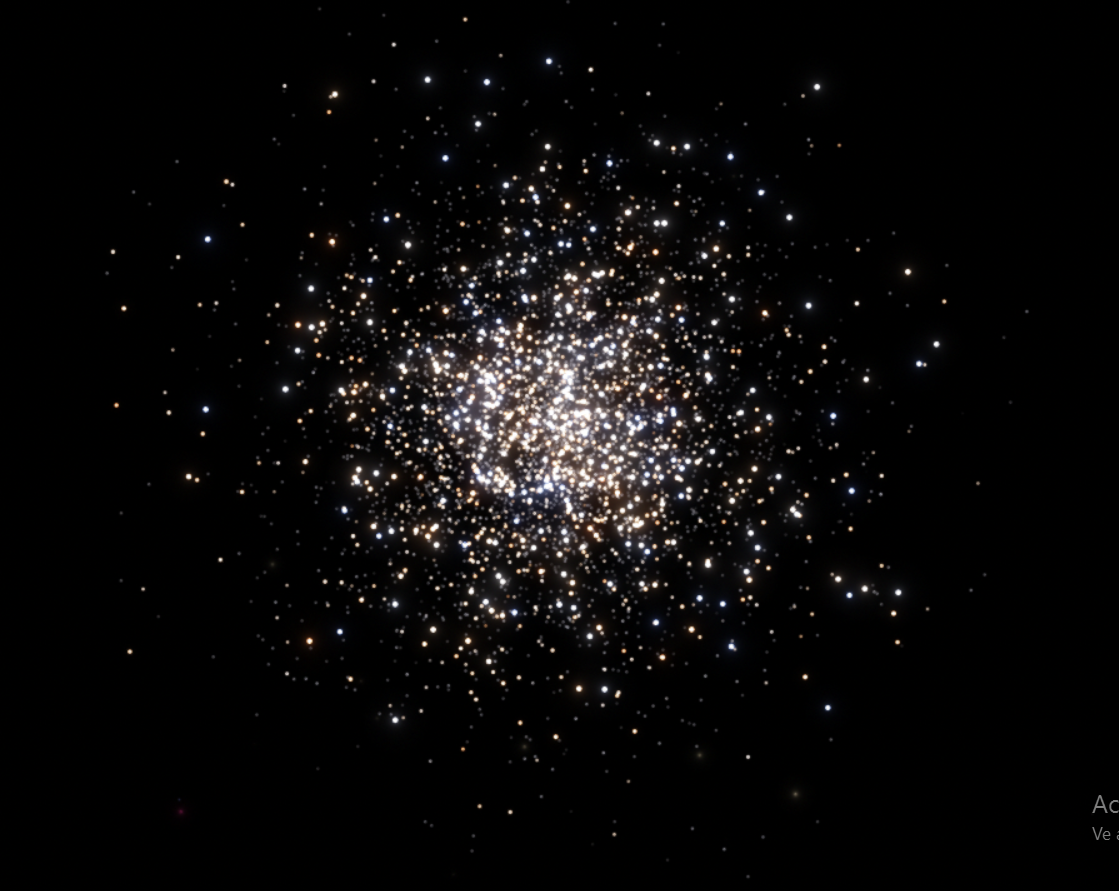
Globular Clusters are groups of old stars, they have between 100,000 and 1 million stars and are denser than open clusters.
In the Milky Way globular clusters are located in the galactic Halo.
Open Clusters are groups of young stars, they have a few thousand stars, these stars were formed from the same giant molecular cloud, and are united by their mutual gravity.
In the Milky Way open clusters are located in the galactic disk.
Milky Way, catch taken in space simulator SpaceEngine.
Milky Way is a barred spiral galaxy (Class SBc), it's the second largest galaxy in the local group and is the galaxy that contains our Solar System.
It's formed by clouds of gas, cosmic dust, dark matter, energy, planets and stars all these structures are linked by the existence of gravity and they revolve around the center of the galaxy
It has a mass of 0.8–1.5×10^12 M☉, a diameter of 126090 light-years and contains 270 billions of stars approximately, also it has 10668 Clusters and 12410 Nebulae.
Parts of the Milky Way are: Halo, Disk and Bugle.
Halo: It's made up mainly of Dark matter, Clusters and older stars. Disk: The disk is composed of 8 spiral arms,they have most of the nebula, gas and dust in the galaxy and the younger stars.
Bugle: It's the central group of stars and contains the supermassive Black Hole Sagittarius A* (Sgr A*)
(If you want to know more about the supermassive black hole at the center of the galaxy press here).
Jupiter, catch taken without realist brightness
since SpaceEngine.
Jupiter is the fifth nearest planet to the Sun (Disregarding dwarf planets), and the largest planet of the Solar System. its names comes from the Greek deity Zeus (Jupiter in Roman mythology) this planet like Saturn has rings, but it has very few rings so that almost cannot be seen.
Jupiter is a Cold Gas Giant, located between Ceres (Dwarf Planet) and Saturn, its mass is 317,8 M⊕ (317 times the mass of the Earth), and it has a diameter of 139822 km, therefore, its density is 1.33 g/cm³ so it's one of the planets with lower density.
Jupiter is formed mainly from hydrogen and Helium, it doesn't have a solid surface defined, and its atmospheric pressure is 1x10 (exponent 6) atm, that is to say, 1 million times the atmospheric pressure on earth.
Jupiter has 63 natural satellites, but the largest are Io, Europa, Ganymede and Callisto, Ganymede is the largest Satellite of Jupiter and the largest satellite in the Solar Sistem, its diameter is 5262 Km, and it is larger than Mercury.
Neutron Star captured without auto exposure in SpaceEngine.
Neutron Star is a kind of "Compact Star", its mass is 1.35 to 2.1 M☉ (1.35 to 2.1 times the mass of the Sun), and its diameter is a few kilometers (20 kilometers approximately), Therefore it's a object very dense and its gravitational field is too strong.
It originates from the gravitational collapse of a main sequence star with a lot of mass, as a Blue supergiant. When a massive star has a supernova explosion the star collapses by its own weight, then its diameter decreases.
(In the picture: As this object has a very strong gravitational field visible light from the Milky Way and the stars behind it is deviates)
Life cycle of a dwarf star and a massive star.
Neutron Stars are formed manly by neutrons, also have other types of particles inside and they are considered degenerate matter because much of their pressure comes from the Pauli exclusion principle.
Some Neutron Stars are Pulsating Radio Stars (Pulsar), they emit a beam of electromagnetic Radiation, these emissions are moved due to the rotation of the star and are produced due to the matter that the star absorbs its accretion disk.
Revolving around of PSR B1509-58 (And its accretion disk), this GIF is taken with SpaceEngine
(The beam of electromagnetic radiation emitted by the star isn't visible from this capture).
"Artistic representation" of a pulsar. This GIF is Taken With Universe Sandbox. This image shows the beam of electromagnetic radiation emitted by a Pulsar, but it isn't realistic.
White Dwarf captured since space simulator SpaceEngine.
A White Dwarf is a kind of "Compact star", it is formed by main sequence Star whit a similar mass to the Sun (Yellow Dwarf).
White Dwarf is a object with stellar mass and with a similar diameter of a terrestrial planet, therefore, it's a object very dense and its gravitational field is very strong.
White Dwarfs are among the most abundant stars, are part of the life cycle of a star of less than 10 solar masses. They consist of stars that have merged all its hydrogen atoms in their life cycle, and cannot make further thermonuclear mergers that allows them to release energy as light and heat, then they cooled and the pressure gas isn't enough to keep all the mass of the star and this begins to collapse under its own weight, the matter of the star is compressed so that this reaches similar size to earth but with the mass of a star.
Life cycle of a dwarf star and a massive star.
Sirius B, The closest white dwarf captured with SpaceEngine:
Black Hole near a star cluster captured whit SpaceEngine.
A stellar Black Hole is a "Compact Star", it has a mass greater or equal to 2.5 M☉ (greater to 2.5 times the mass of the sun), and has a diameter of a few kilometers, therefore, is a extremely dense object, this means it has an extremely strong gravitational field, so that everything that gets close enough to this is trapped by its field and is absorbed.
Black Holes have a very dark color, but they´re not completely black, this is due to emissions of Hawking radiation in their "Event Horizon"
Event Horizon is the limit of the Black Hole, beyond that nothing can leave, don't even photons (Light).
This is the life cycle of different stars, the most massive are those that become Black Holes
Types of Black Holes:
If they are classifieds according to their mass, exist three types of Black Holes:
Supermassive Black Hole: They have a mass of millions of solar masses and are at the center of all galaxies.
Stellar Black Hole: They are black holes that are part of the life cycle of the stars of a mass equal to 30-70 solar masses (After the supernova a big star loses some of its mass and the remainder is pressed into this type compact star).
Micro Black Holes: They are the smallest Black Holes, their diameter is up to 1 mm (millimeter), however they are also very dense.
Milky Way is a spiral galaxy, it is formed by clouds of gas, cosmic dust, dark matter, energy, planets and stars all these structures are linked by the existence of gravity and they revolve around the center of the galaxy, also The Sun revolves around the center of the galaxy at a speed of 220 Km/s.
If the structures that exist in the galaxy revolve around galactic center then what about the center?
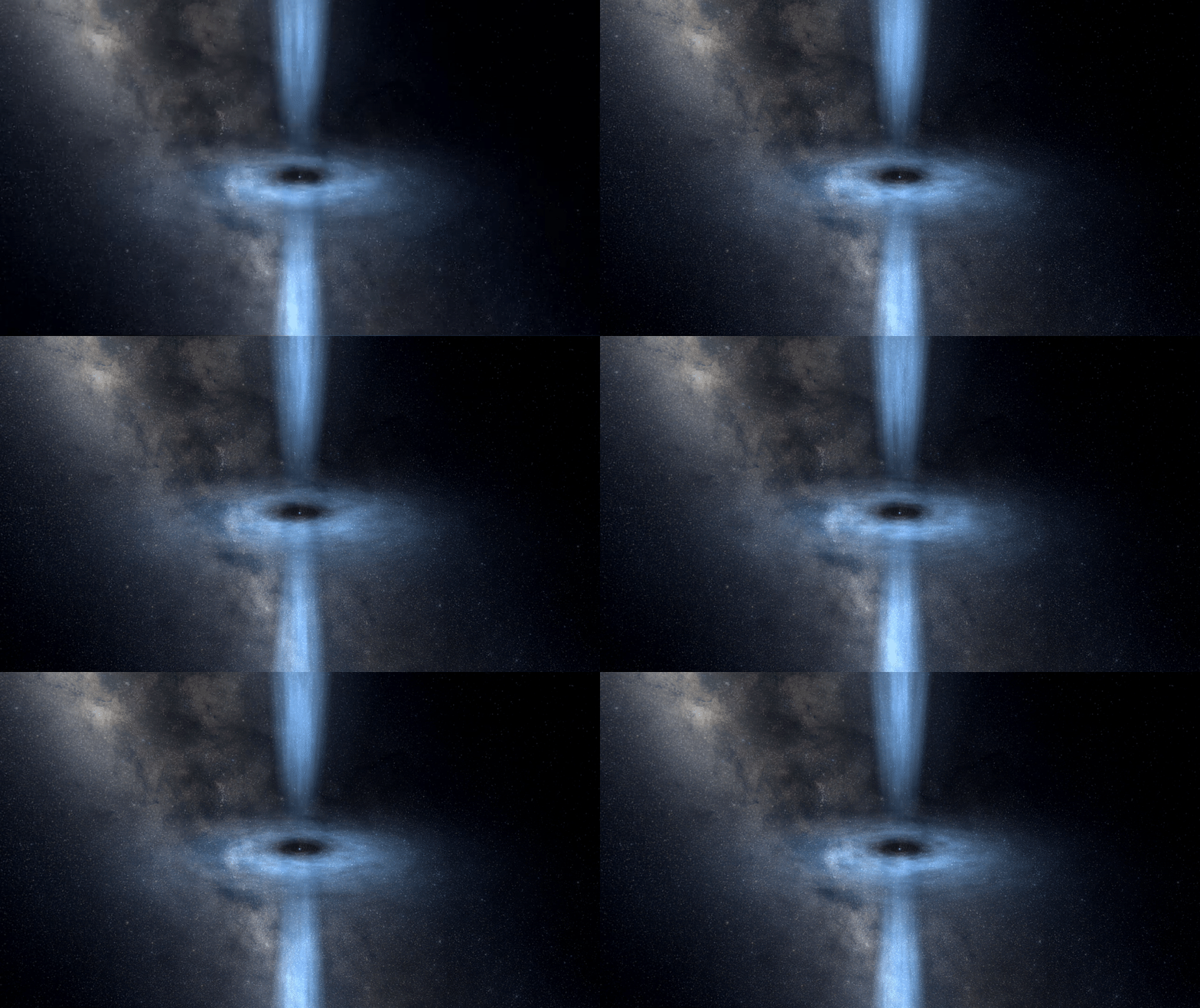
Catch of the accretion disk of Sagittarius A * taken from
In the center is a supermassive black hole its name is Sagittarius A* (Sgr A*).
Sgr A* has a mass of 4.31*10 (Exponent 6) Solar masses, that is to say, 4 million times the mass of The Sun. it has never been seen (because it doesn't emit radiation in the form of light), but it exist by the mysterious movement of the nearest stars, and of all the Galaxy.
In the Center of the galaxy there are many stars, and emits large amounts of radiation.
The movement of the accretion disk of Sagittarius A * and its stars, along with the black hole recorded from spaceengine looks like this:
Saturn is the sixth nearest planet in the solar system (Disregarding dwarf planets).And the second largest, surpassed only by Jupiter. Its name comes from the Greek deity Chronos (Saturn in Roman mythology) and because of its huge layer of rings is the most striking planet in the Solar System.
Saturn's Capture take without realist brightness from Space Simulator SpaceEngine.
Saturn is a Gas Giant Planet, located Between Jupiter and Neptune, it has a mass of 95,16 M⊕ (95 times the mass of the Earth), and a diameter of 116464 km, however it is a planet with very low density (687 kg/m³ or 0,687 g/cm³), Saturn is less dense than water.
Saturn has 31 natural satellites, but the largest are Mimas, Enceladus, Tethys, Dione, Rhea, Titan and Lapetus. Titan is the largest satellite of Saturn, and the second largest satellite in the solar Sistem, its diameter is about half the diameter of the earth.
Saturn rings rotate at a speed of 48000 km/h and are made up of rocks and particles are trapped by the planet's gravity.
Pluto: It is a dwarf planet discovered in 1930 by american astronomer Clyde William Tombaugh, it is a TNO (Trans-Neptunian object), that is, it is beyond the orbit of Neptun, also is the object biggest of the Kuiper Belt.
Its orbital period is 248 years, however as it has a very eccentric orbit, Pluto is closer the Sun than Neptune for 20 years (at perihelion).
during the rest of the time Pluton is farther from the sun than Neptune.
Pluto has 5 Satellites, these are: Charon, Styx, Nix, Kerberos, and Hydra. The largest satellite pluto is Charon and both form a binary system
Binary System:
In astronomy a binary system is when two objects (planet and moon) have similar Mass and are very close, they undergo an attractive force, equal in magnitude but in the opposite direction (as explained by the law of universal gravitation of Newton) then both they revolve around a midpoint called centroid.
In the case of our planet is a Planet-Satellite system, Earth has a significantly higher mass than the moon, Therefore it apparently not revolve around a point in space, but revolve on its own axis
Charon's Gravity pulls Pluto making that it isn't only has an orbit around the sun (Like the other planets), but also has an orbit which rotates on its own axis, while performing a movement of elliptical trajectory around the centroid. If Charon never existed what about Pluto?
If Charon never existed things to Pluto would be diferent, no longer would form a binary system the process of rotation would be like that of the other planets (on its axis) and rotation period would be greater, (would take more than the 6.38 Earth days currently used for a spin on its axis).
Similarly if the moon had never existed, the days on Earth would be much longer.
How would look Charon from Pluto's surface?
Currently, No one has traveled and landed in Pluto, but if we were on Pluto and we looked Charon, we haven't seen a change in position on the surface of the planet.
This is because the period of rotation of Pluto is 6.38 days and Charon completes a revolve in its orbit around the planet in the same period of time, therefore, if we were standing on the surface of the planet, we would observe that Charon don't would have a relative movement.
This is seen from the space simulator spaceengine looks like ...